HS 2028: what the new codes could change for your products

HS 2028: what the new codes could change for your products
The Harmonized System changes because the goods being traded change. New products appear, existing markets grow, and customs authorities need more precise ways to distinguish goods that previously sat under broad headings.
The next revision takes effect on 1 January 2028. HS 2028 is the eighth edition of the World Customs Organization's Harmonized System and contains 299 sets of amendments. Six new headings and 428 new subheadings are being introduced, while others will be deleted or reorganised.
For EU traders, these changes will later be reflected in the Combined Nomenclature (CN), which is based on the HS, and in TARIC. A product that has one classification today may consequently need a different or more specific code from 1 January 2028.
That is the part businesses need to prepare for.
Why some products are getting new codes
A large part of HS 2028 concerns goods that have become difficult to identify properly under the existing structure.
Protective face masks are a good example. Under HS 2022, many textile protective masks are classified within subheading 6307 90, which covers 'other' made-up textile articles. HS 2028 creates separate subheadings for protective face masks. New subheading 6307 31 covers protective masks that meet the conditions set out in the new Chapter 63 note, while 6307 39 covers other protective face masks.
Vaccines are also being reorganised. Products currently covered under heading 3002 will be divided between new heading 3007 for vaccines for human medicine and heading 3008 for other vaccines, including veterinary vaccines. The human vaccine heading will contain further detail based on the diseases the vaccines target.
Dietary supplements receive a new heading of their own. Under the current HS, these products can fall under different headings depending on their composition. HS 2028 introduces heading 2107 specifically for dietary supplements, with separate subheadings for products supplied in measured doses and other preparations put up for retail sale.
Environmental controls have also influenced the revision. Heading 3915 for plastic waste is being restructured so that different categories of plastic waste can be identified more precisely, including hazardous waste and waste subject to controls under the Basel Convention. New distinctions are also being introduced for certain single-use plastic products.
These examples show what HS revisions actually do. Some goods remain in broadly the same part of the nomenclature but receive a more precise subheading. Others move into newly created headings because the existing structure no longer describes the market adequately. For the wider changes by chapter, see 'HS 2028 revision: key changes and how to prepare', CCRM 37, 2026.
A new code can affect more than the customs declaration
A change in classification matters because customs measures are attached to tariff codes. The classification can affect the customs duty payable on import. It can also determine which licences, certificates, prohibitions, trade defence measures or other requirements apply to the goods.
The EU's Combined Nomenclature uses eight-digit codes and is based on the international HS. TARIC then adds further EU measures linked to those classifications. The CN is updated each year and incorporates relevant international HS changes.
Businesses with products affected by HS 2028 will therefore need to follow the corresponding EU changes before the new system takes effect.
Existing Binding Tariff Information (BTI) decisions also deserve attention. A BTI is generally valid for three years, but it can cease to be valid earlier when the nomenclature changes and the decision no longer conforms to the law. The Commission specifically identifies a change to the CN or a nomenclature based on it as one reason a BTI may cease to be valid. A BTI that runs beyond 1 January 2028 should not simply be assumed to remain usable if the classification on which it was issued has changed.
The practical work can begin before 2028. Companies can identify the products they classify frequently, compare their existing HS codes with the WCO's HS 2028 correlation tables and note where a code has been divided, replaced or moved. The WCO has published correlation tables between HS 2022 and HS 2028 for this purpose, although it states that they are guidance and do not have legal status.
The older HS versions still matter for origin
Moving to HS 2028 does not mean that every customs rule will immediately use the same edition of the Harmonized System.
Preferential rules of origin are set by individual trade agreements or preferential arrangements. Their product-specific rules are organised by HS classification, but the HS version used depends on the agreement concerned. The EU-Japan Economic Partnership Agreement, for example, sets out its product-specific rules using the HS 2017 classification.
This creates a practical distinction. The code used for the EU tariff may follow the latest nomenclature, while a preferential origin rule may still have been drafted using an earlier HS edition.
A company claiming preferential origin may therefore need to relate the current classification of its product to the HS version used in the relevant agreement before it can identify the correct product-specific rule. HS 2028 adds another edition to that work. It does not remove the older ones.
For more on the relationship between HS versions and EU preferential agreements, see 'Preferential trade arrangements of the EU: a non-systematic glance at the current non-uniformity', CCRM 2, 2020.
Use case: protective face masks
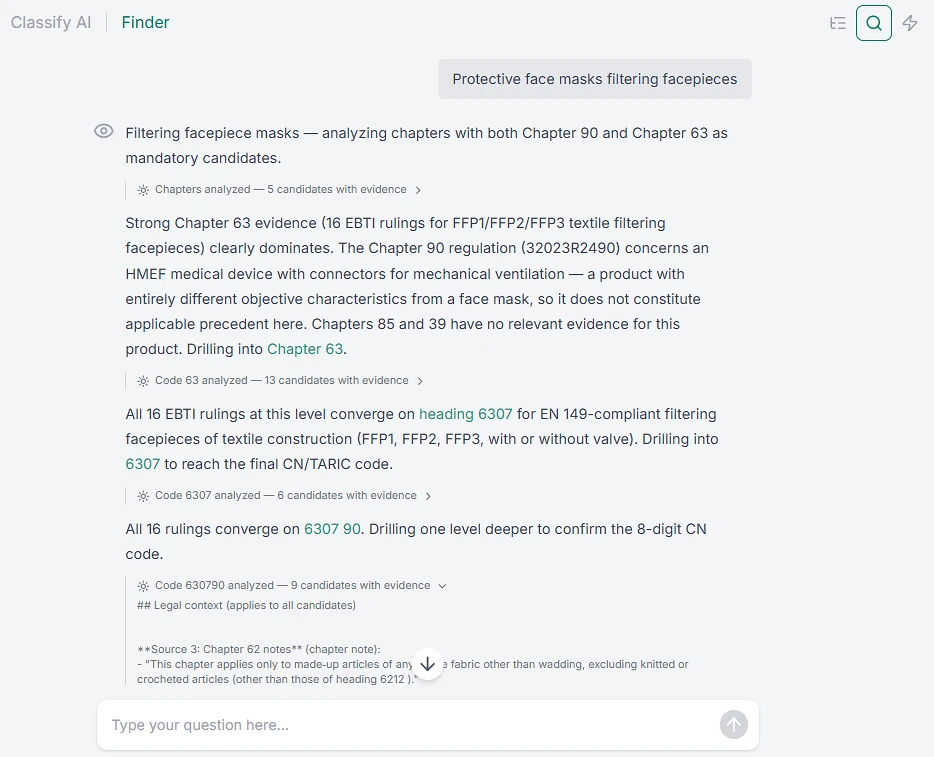
Consider filtering facepiece masks such as FFP1, FFP2 and FFP3 products. A trader using Classify AI's Finder today can search for the appropriate classification based on the product characteristics and available classification evidence.
For qualifying textile filtering facepieces, Finder can identify Chapter 63 as the relevant area and narrow the classification through heading 6307. Under the present nomenclature, these products can fall within subheading 6307 90 for other made-up textile articles.
HS 2028 changes that structure. From 1 January 2028, protective face masks currently contained within 6307 90 are separated into new subheadings. Subheading 6307 31 will cover protective masks designed to fit closely to the face and filter airborne particles where they meet the standards and certified filtration conditions specified in the new Chapter 63 note. Other protective face masks will fall under 6307 39.
The product itself has not changed. The nomenclature used to describe it has. For a trader that regularly imports or exports these masks, that means the classification data used today will need to be reviewed before HS 2028 takes effect.