You have the commodity code. What TARIC tells you before import, and what it leaves out
You have the commodity code. What TARIC tells you before import, and what it leaves out
The classification is settled. A French importer is planning to bring in aluminium wire from China, not alloyed, maximum cross-sectional dimension over 7 mm - commodity code 7605 11 00. Before the declaration can be lodged, someone has to establish what applies: the duty rate, any lower rate the goods might qualify for, any control that has to be satisfied before release, and what will be payable in France on top of the duty.
The obvious place to start is the TARIC consultation. It is authoritative, free, and updated daily. It is also the source of the whole answer for exactly one part of that list, and the source of none of it for another.
What makes this harder than looking up a rate
Open TARIC for that code, that origin and today's date, and the screen returns five measures, nine footnotes and three sets of conditions behind links.
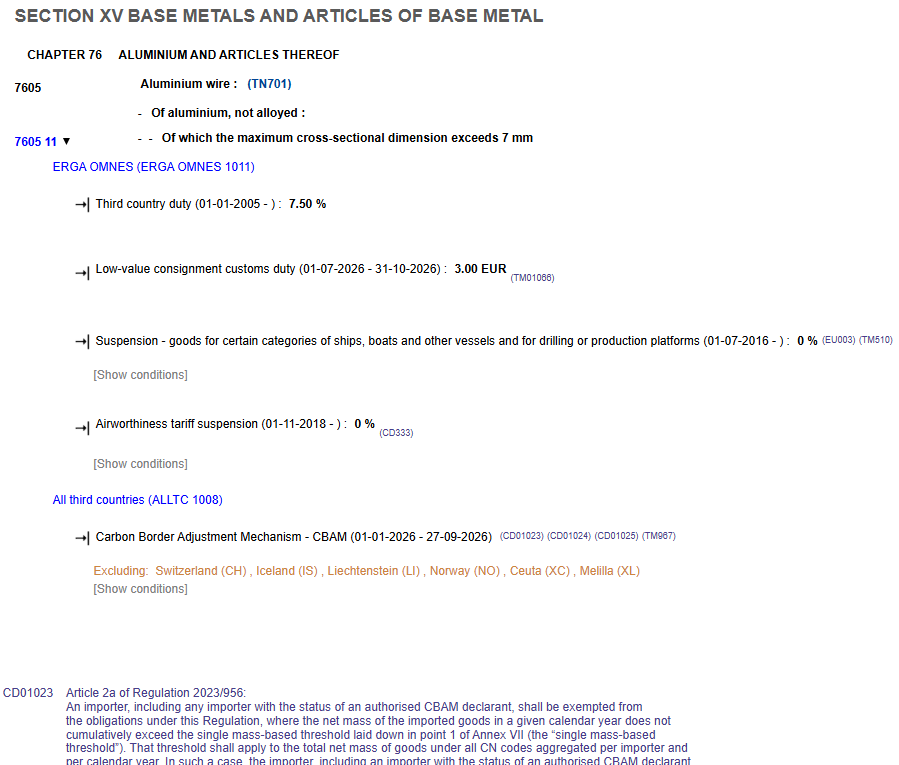
Five things about that page are worth understanding, because they are what turns a lookup into a task.
The page answers a wider question than the one you asked
TARIC returns everything attached to the code and the geographical area, not everything relevant to your consignment. For this code, that includes a duty suspension for goods incorporated into ships, boats and drilling platforms, a suspension for parts used on aircraft, and a customs duty of 3 euro per item that applies only to consignments with an intrinsic value up to 150 euro. A nomenclature footnote on the heading sets out the import prohibition on goods originating in Crimea, Sevastopol and the non-government-controlled areas of four Ukrainian oblasts - relevant to origin, not to this shipment, but you have to read it to establish that. None of it is labelled as applicable or not. That judgment is yours.
The measure lines are three different kinds of thing, presented alike
A third country duty is what you pay by default. A suspension is a rate you may claim, but only if the goods meet a defined end use and you can produce the document that proves it. A control such as CBAM is not a rate at all - it is a requirement without which the goods are not released. Reading the page correctly means sorting the lines into those three categories first, because they carry completely different consequences if you get them wrong.
The information is layered
A measure line gives a rate and a code in brackets. What the code means is further down the page, under a separate heading. To understand the CBAM line, you collect four codes, scroll to four blocks of legal text, read them, and scroll back.
The conditions - which are what you actually declare - are behind a link
Until you open 'Show conditions', you know a 0% rate exists for aircraft parts, but not that it requires an Authorised Release Certificate, and not which document code goes into the declaration. The rate is visible; the thing you have to type is not.
Geography is often expressed by exclusion
CBAM is shown against 'All third countries', followed by 'Excluding: Switzerland, Iceland, Liechtenstein, Norway, Ceuta, Melilla'. To establish that it applies to China, you read the exclusion list and confirm China is not in it.
And then there is what TARIC does not carry at all. Import VAT is not there. National taxes are not there. Those are national law, and for France they are in RITA, the national tariff encyclopaedia. The check that began in one system finishes in another.
The workflow
Stated plainly, the sequence is:
commodity code → origin → country of import → third country duty → conditional rates and the documents each one requires → controls and their document codes → national VAT and any national taxes → the sources checked and kept.
The first two steps are done. Everything after 'country of import' is the work, and it is repeated for every code and every origin in the shipment.
Where the assistant enters
Smart Taric AI is useful at the measures step. You ask about the commodity code, the origin and the country of import, and the answer is assembled in the order the decision is made rather than the order the database stores it: the duty you will pay, the lower rates and what each requires, the controls with their document codes, and the national tax. Every answer carries the links behind it - the TARIC consultation for that exact code, origin and date, and the national source - so the answer can be checked against the originals rather than taken on trust.
The example
Question: Import 76051100 from China to France
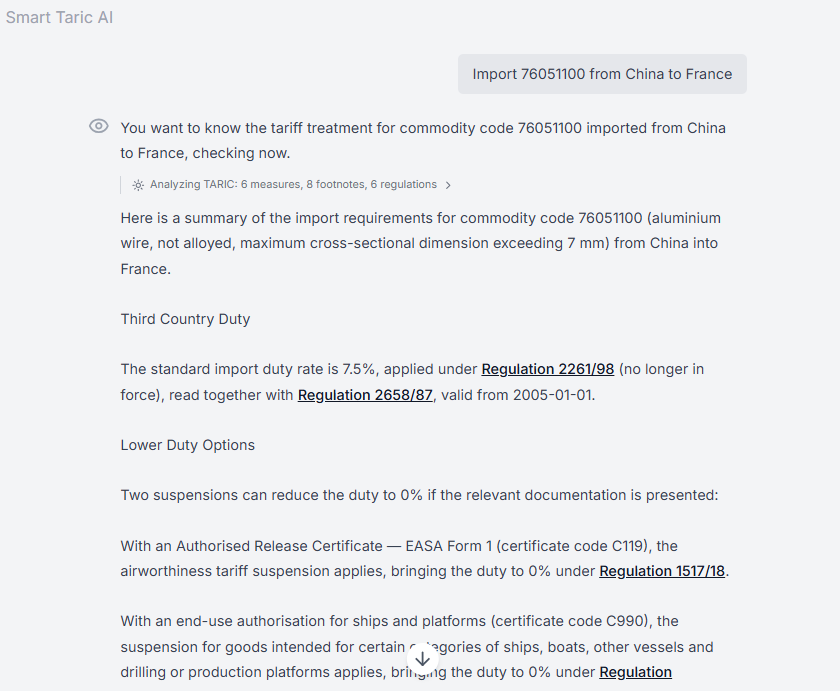
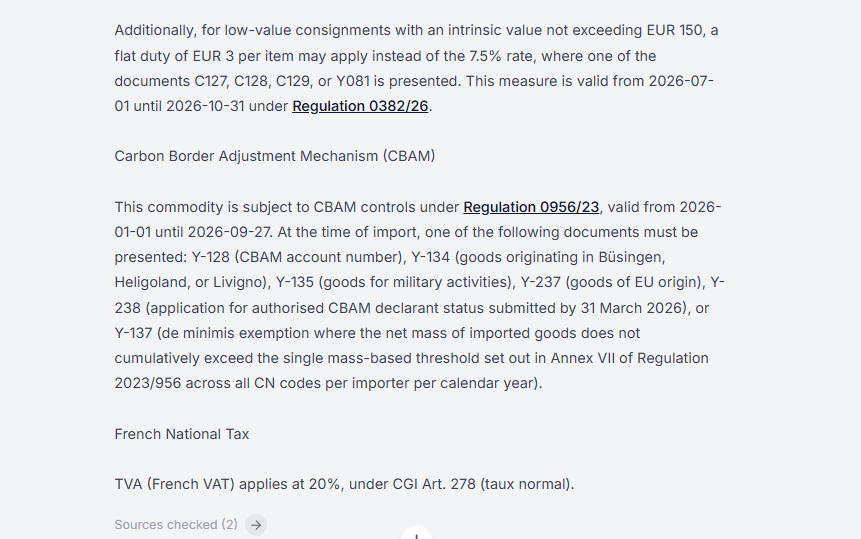
The result, read in order.
The third country duty is 7.5%, under Regulation 2261/98 read with Regulation 2658/87, valid from 1 January 2005. The regulation numbers link to the consolidated texts on EUR-Lex, and where a regulation is no longer in force in its original form the answer says so rather than leaving it to be discovered.
Two lower rates follow, each with its condition attached. A 0% rate for parts and components for aircraft, on presentation of document C119 - the Authorised Release Certificate, EASA Form 1, or an equivalent. A 0% rate for goods for ships, boats and drilling or production platforms, on presentation of document C990, the end-use authorisation. In TARIC, these are two measure lines with the certificate described in prose behind a link. Here the option and the document arrive together.
Then the control. The commodity is subject to CBAM, and one of six documents must be presented: Y-128, Y-134, Y-135, Y-237, Y-238 or Y-137. The codes come with their meanings, which is the difference between a list and an answer - Y-237 is goods of EU origin, Y-134 is goods originating in Büsingen, Heligoland or Livigno, Y-238 is an application for authorised CBAM declarant status submitted by 31 March 2026, and Y-137 is the de minimis exemption where the importer's total net mass of CBAM goods does not exceed the Annex VII threshold across the calendar year.
Finally, the national layer: French VAT at 20%, under Article 278 of the General Tax Code. That is not in TARIC, and here it is one more line.
The follow-up. The answer does not have to be complete on the first pass, because any part of it can be questioned.
Question: can you explain this more in detail? Y-128
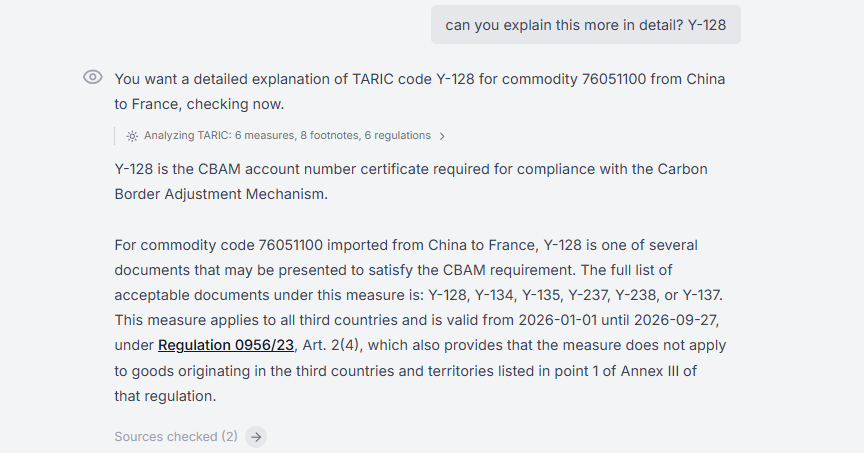
Y-128 is the CBAM account number, with the regulation, the period it applies for, and one thing that was not asked: Article 2(4) excludes goods originating in the countries and territories listed in point 1 of Annex III, and China is not among them, so the requirement applies in full.
What the practitioner should verify
-
Whether the goods genuinely meet the end-use conditions before a 0% rate is claimed, and whether the authorisation and certificate are in hand rather than expected. A suspension claimed without its document is a duty underpayment, not a pending formality.
-
Which CBAM document applies to this importer. The de minimis threshold is assessed on the total net mass of all CBAM goods, aggregated per importer across the calendar year - not per consignment - so a code that was right in January can be wrong in October.
-
How the French VAT will be accounted for, which is a separate question from the rate. [Internal link: article on procedure 42, fiscal representation and VAT auto-liquidation in France.]
-
The two source links, opened and read for anything that carries real money.
What TARIC does - and where the work continues
TARIC is complete and authoritative, and it is built for the system rather than for the reader: measures that belong to someone else's consignment, codes whose meaning sits elsewhere on the page, the document requirements one click further in, and no national tax at all. Reading it properly is a skill. Reading it twelve times before Friday is a workload.
Run the same check for your own commodity code and origin in Smart Taric AI.