Importing to multiple EU countries? Smart Taric AI provides national tax rates

Importing to multiple EU countries? Smart Taric AI provides national tax rates
Duty rates are harmonised across the European Union. National import taxes are not.
That is the practical problem for any company supplying more than one EU market. The commodity code and the origin give you one duty answer for the whole customs union. Change the country of import and the VAT rate can change, an excise rate can change, and a national tax can appear that exists nowhere else.
So where do you find those national rates? In some member states, a national tariff database extends TARIC with the national measures. Where no such database exists, you are reading national legislation on a national portal, in a language you may not work in. Either way, it is search time, repeated for every destination.
Smart Taric AI answers that question directly. You ask about a commodity code, an origin and a country of import, and the answer comes back with the rate, the legal basis, the date of effect and links to the sources. It reads TARIC and the national measures for you, so the EU duties and measures and the national tax layer arrive together.
Two examples
Tariff classification is only half the picture. VAT rates, excise duties, and reliefs for the same commodity code can differ sharply from one member state to the next. The two examples below show how Smart Taric AI surfaces these destination-specific charges for the same product and origin.
Example 1: roasted coffee, commodity code 0901 21 00, from Brazil
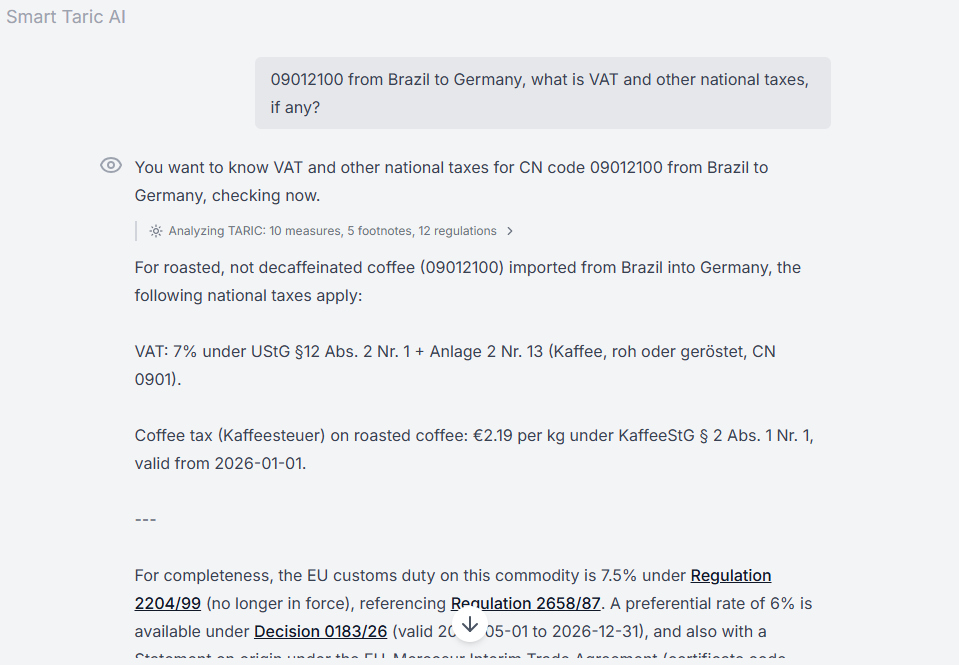
Question: 09012100 from Brazil to Germany, what is VAT and other national taxes?
Question: 09012100 from Brazil to the Netherlands, what is VAT and other national taxes?
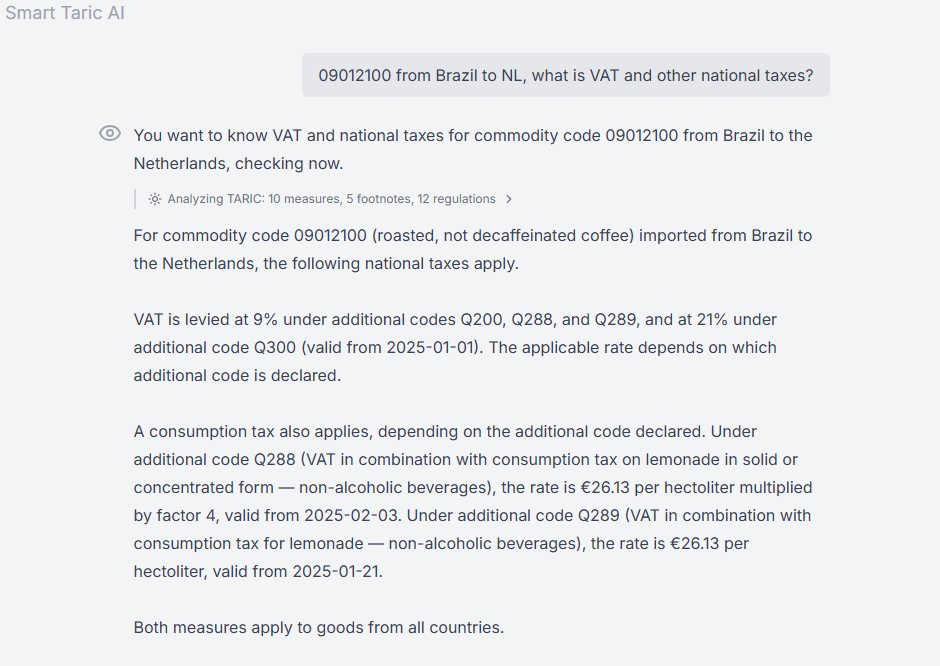
Germany applies VAT at 7%, the reduced rate for coffee, and a coffee tax of 2.19 euro per kilogram of roasted coffee, in force from 1 January 2026. The Netherlands applies VAT at 9% under additional codes Q200, Q288 and Q289, and at 21% under Q300, plus a consumption tax on non-alcoholic beverages of 26.13 euro per hectolitre, multiplied by a factor of four under Q288.
Same code, same origin, same product. Germany taxes the coffee by weight, the Netherlands by volume, and in the Netherlands the additional code decides both the VAT rate and the consumption tax.
Example 2: beer, commodity code 2203 00 01, from Thailand
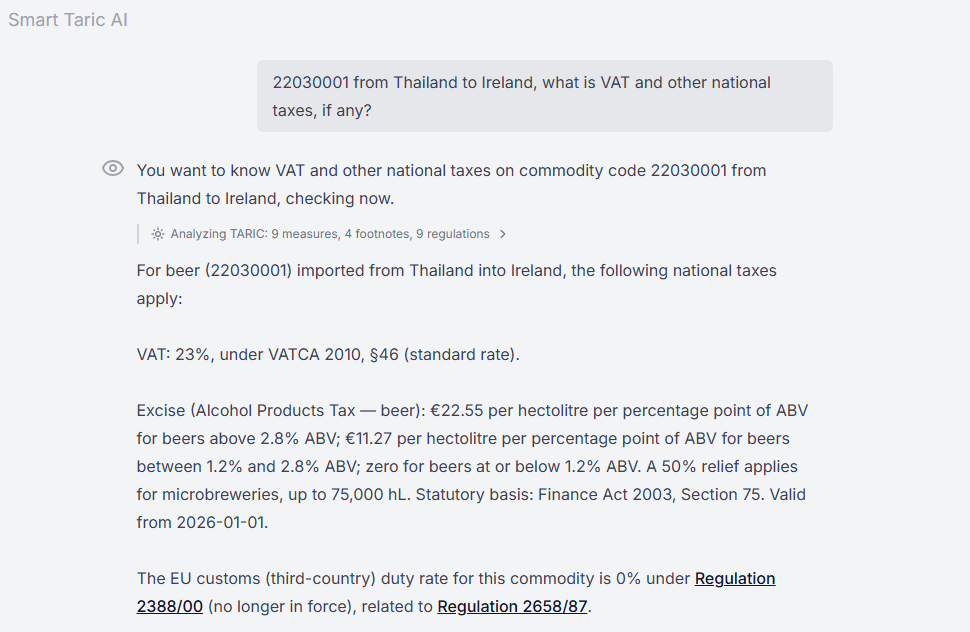
Question: 22030001 from Thailand to Ireland, what is VAT and other national taxes?
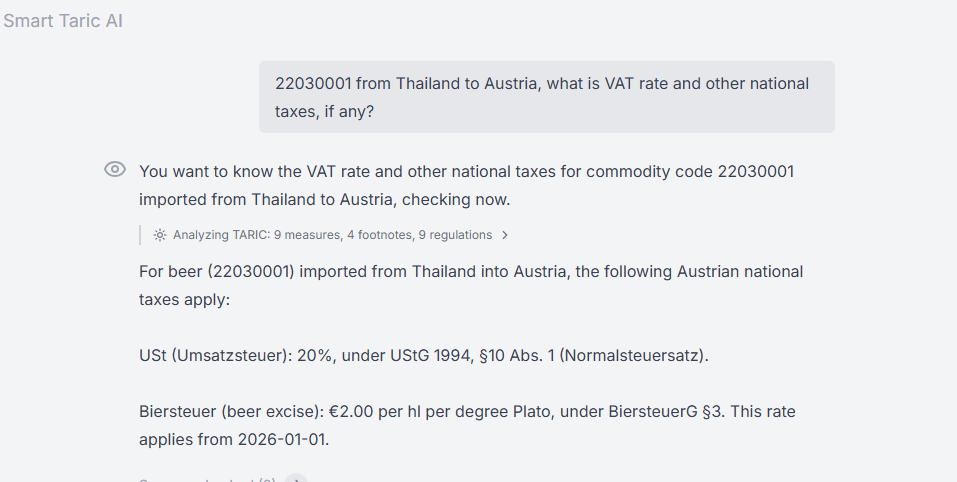
Question: 22030001 from Thailand to Austria, what is VAT and other national taxes?
Ireland: VAT at 23% and Alcohol Products Tax at 22.55 euro per hectolitre per cent of alcohol for beer above 2.8% ABV, 11.27 euro for beer between 1.2% and 2.8%, and nil at or below 1.2%, with a 50% relief for microbreweries producing up to 75,000 hectolitres.
Austria: VAT at 20% and beer tax at 2.00 euros per hectolitre per degree Plato.
Put the two answers side by side, and you see something a rate comparison on its own would hide. The two countries do not measure the same thing. Ireland charges by alcoholic strength by volume. Austria charges by degree Plato, the original wort content, with fractions of a degree disregarded. Directive 92/83/EEC permits both. Before either tax can be calculated, the same consignment therefore needs two different figures from the brewery.
The small-producer reliefs differ too, and they matter for a third-country brewery. Austria reduces the rate to 60%, 70%, 80% or 90% depending on annual output up to 50,000 hectolitres, but grants it only by way of refund, claimed for full calendar years. Where the beer comes from another member state or a third country, an official confirmation of the foreign brewery's annual production and of its legal and economic independence has to be produced. Ireland's relief is a flat 50% up to 75,000 hectolitres. For a Thai brewery, that is the difference between a relief you can price into the offer and one you have to establish first, with a document from home.
The sources are in the answer – easily to check national rules
Each answer carries links, and the links are the reason to trust the figure.
One goes to the EU TARIC consultation for that exact commodity code, origin and date. The other goes to the national source. For Ireland, that is the Revenue page of excise duty rates, with the full Alcohol Products Tax table - spirits, beer, wine, cider and perry - and the date it was published. For Austria, it is the consolidated Biersteuergesetz 2022 on the federal legal information system, in the version applicable on the date of the query, where section 3 gives the rate, the definition of degree Plato and the relief conditions.
The Austrian example also makes the language point. The source is in German. The answer tells you which provision to read, which turns an open search into a check you can complete.
Beyond the rates: how these flows are structured
Rates are the starting point. Companies importing into several member states usually go on to ask a second question: where should the goods be declared, and who accounts for the VAT? Three instruments come up, and each one carries national conditions of its own.
Centralised clearance for import
Centralised clearance lets an authorised economic operator lodge the customs declaration at the customs office responsible for the place where it is established, even when the goods are presented in another member state. A company established in Poland, for example, can declare in Poland goods presented in Hamburg.
It is an excellent simplification, and the customs side of it is largely uniform. The tax side is not. Import VAT is due where the goods are located, while the VAT Directive leaves the applicable rate, payment arrangements and person liable to each member state.
This means that an authorisation covering three member states of presentation can bring three different sets of national tax rules with it. Our glossary explanation of centralised clearance for import (CCI) looks more closely at how these uniform customs rules interact with national VAT requirements.
Procedure 42 and fiscal representation
Where the goods are released in one member state but destined for another, customs procedure 42 exempts import VAT, on condition that an intra-Community supply follows immediately. VAT is then paid by the final consignee in the member state of destination.
The same instrument, and again national conditions. France is a good illustration of how quickly they move. Until 31 December 2025, an importer established in a third country could use ad-hoc fiscal representation and avoid registering for VAT in France. The Finance Act for 2024 ended that possibility, with implementation postponed to 1 January 2026.
Since 1 January 2026, the position of a non-EU importer depends on whether its country of establishment has concluded a mutual assistance agreement for the recovery of tax claims with France. Without such an agreement, the importer must appoint a permanent fiscal representative accredited by the French authorities, who registers it for VAT and takes on the invoicing, accounting and reporting obligations. With such an agreement, the importer registers for VAT with the Tax Department for Non-Residents and may delegate its reporting to a permanent fiscal agent - but the agent acts under the principal's responsibility, and the principal remains solely liable.
The declaration data are equally specific. Procedure 42 is shown in the additional fiscal reference field, as FR7 plus the VAT number of the importer or its representative, followed by FR2 plus the VAT number of the recipient in the member state of destination, together with code G6030. The invoices must carry the wording 'VAT exemption - Article 262 ter I of the French General Tax Code'.
Once registered in France, a company can also use procedure 40 with the VAT auto-liquidation mechanism: import VAT is no longer payable when the declaration is lodged, but reported as VAT due and, at the same time, as deductible VAT on the periodic return.
These are the French rules. The next member state on your list will have its own.
Learn more in the article ‘Application of Customs Procedure 42 in France and its recent developments’ by Evguenia Dereviankine, CCRM Issue 36 (2025/2026).
Transit
Transit is the third option. The goods move as non-Union goods to the member state where they will actually be released, and both the duty and the national taxes then arise there, under that country's rules. It removes the mismatch between the place of declaration and the place of taxation, at the cost of a guarantee and a movement to manage.
What it adds up to
There is more than one way to organise an import flow for financial efficiency. Which one fits depends on where the goods are released, who is established where, and what each member state requires - and the conditions change, as France has just shown.
All of it rests on knowing the national position for a given commodity code and country of import, and knowing it quickly. That is where Smart Taric AI helps: the EU measures and the national taxes in one answer, with the sources you can open and check.