Best customs compliance software in 2026: 7 platforms compared

Customs compliance software can cover a broader range of work than declaration filing alone. Some platforms focus on submitting customs entries, while others support classification, regulatory research or wider trade compliance. For importers and trade teams, that makes product comparison less straightforward than it first appears.
This guide compares seven customs compliance platforms by examining the functions they perform, the jurisdictions they support, and the types of organisations they suit best. It also distinguishes between software that executes customs processes and tools that strengthen the decisions behind them, helping buyers assess where each platform offers the most practical value.
Why choosing customs compliance software is difficult
Choosing customs compliance software is difficult because products grouped under the same category often solve different problems. Some platforms are built primarily for customs declaration filing, while others focus on classification, sanctions screening, regulatory research, or broader trade management. Enterprise systems can combine these functions, but they usually require greater implementation effort and investment.
This creates a buying risk. A team can compare feature lists, select a platform, and still discover that it does not address the part of the customs process creating the real problem. Before comparing vendors, businesses need to define the operational gap they are trying to close and the level of automation they require. The strongest customs compliance software will depend less on the number of features offered and more on how closely those capabilities match the organisation’s customs workflow.
Key features to look for in customs compliance software
Customs compliance software should be assessed against the controls it can strengthen across the customs process, rather than against the length of its feature list. The most useful capabilities are those that reduce manual work while preserving enough visibility for a practitioner to understand and defend the resulting decision. The features most buyers should examine include:
- Customs declaration filing and validation. The platform should make clear if it can prepare and transmit declarations, validate entry data before submission, or only support the research behind the filing.
- Tariff classification and customs measures. Strong systems should help users determine the correct commodity code and identify the measures associated with it.
- Sanctions and export-control screening. This has become crucial for businesses trading across several jurisdictions or handling sensitive products.
- Regulatory source traceability. Users should be able to follow a recommendation back to the legal or regulatory source supporting it.
- Jurisdictional coverage. A platform built around one customs territory will serve a different buyer from software designed for multi-country operations.
- ERP and API integration. Integration matters where customs decisions or declarations need to move directly into wider operational systems.
These criteria also provide a more useful basis for comparing vendors, because they show where each product actually sits within the customs workflow.
How we selected and evaluated the customs compliance software
The platforms in this comparison guide were selected because they represent different parts of the customs compliance market rather than seven variations of the same product. The aim was to include software used for declaration filing, customs management, tariff and regulatory research, sanctions screening, and broader trade compliance, so that the comparison reflects the choices buyers actually face.
Each platform was then examined against the criteria outlined above. Particular attention was given to customs filing capability, classification support, regulatory coverage, source traceability, jurisdictional reach, integration options, and the type of organisation the software appears best suited to.
We also distinguished between features that form part of the core product and capabilities available only through wider modules or enterprise configurations. The comparison focuses on practical fit rather than assigning artificial scores to products built for different customs functions.
Top 7 customs compliance software providers this year
Choosing the right custom software platform can help businesses streamline operations, improve productivity, and create solutions tailored to their specific needs. In this list, we highlight the top 7 custom software platforms that stand out for their flexibility, scalability, features, and ease of integration. Whether you’re looking to automate workflows, build specialized applications, or support business growth, these platforms offer a range of options to consider. Explore the list below to find the solution that best fits your organization’s goals and requirements.
1. Descartes – broad customs compliance and filing platform
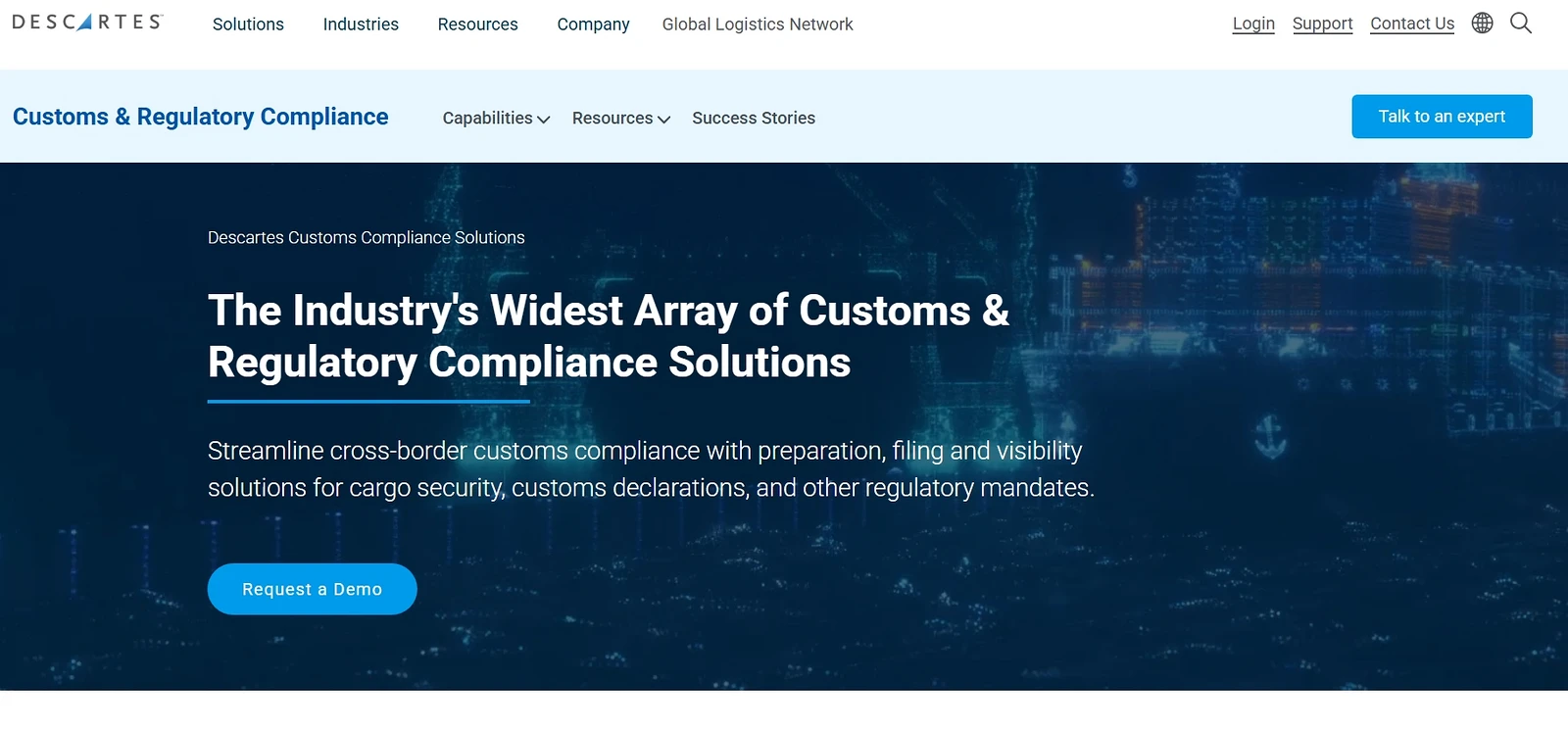
Descartes is one of the broader providers in this comparison because its customs offering extends from declaration filing into tariff classification, regulatory content and other trade-compliance controls. Rather than operating as a single narrow application, Descartes provides a suite of customs and regulatory compliance products that businesses can use according to the jurisdictions and processes they need to manage.
For customs entry work, Descartes supports declaration preparation and electronic filing in several markets. Its EU Customs solution covers import, export and transit declarations, while its US platform connects customs brokers and self-filing importers with CBP through the Automated Broker Interface. Descartes CustomsInfo adds another layer around product classification and trade-content management. Its classification tools provide access to tariff and regulatory information across more than 175 countries, alongside audit trails and structured workflows for maintaining item-level compliance.
The principal advantage is breadth. A business that needs customs filing alongside classification and wider compliance functionality can remain within the Descartes ecosystem rather than assembling several unrelated tools. That breadth also creates its main limitation. Buyers need to establish which Descartes modules they actually require, as declaration software, CustomsInfo and other compliance capabilities sit within a wider product portfolio rather than one simple all-inclusive application.
Descartes facts
Founded: 1981. Descartes Systems Group is headquartered in Waterloo, Canada, and reports more than 2,500 employees worldwide.
Best for: Customs brokers, self-filing importers and larger trade teams that need declaration capability alongside classification, regulatory content and broader customs-compliance infrastructure.
Core strengths: Customs declaration filing, HS and HTS classification, tariff and duty content, item-level compliance management, audit trails, export-control data, denied-party screening and integration with wider trade-management systems.
Client reviews: Descartes Customs & Compliance Suite currently holds a 4.4/5 rating from 82 reviews on G2. Recent reviewers have highlighted ease of use, customs-entry functionality, reporting and sanctions screening. Some users have also reported occasional slow performance, navigation friction and limitations around particular reporting or data-entry workflows.
Customer evidence: Markem Imaje reports using CustomsInfo to centralise tariff research across more than 100 jurisdictions and reduce manual classification work. Meggitt has used CustomsInfo with SAP GTS to automate regulatory-data updates and support classification across international operations.
Core specialties: Customs filing, global tariff content, product classification, customs data management, regulatory research, sanctions and denied-party screening, and enterprise trade-compliance integration.
Advantages: Broad customs coverage, direct filing capabilities in relevant jurisdictions, substantial global trade content, established classification tools and integration options for more complex customs environments.
Disadvantages: The breadth of the portfolio can make product selection more complex. Businesses seeking a lightweight research or AI decision-support tool can find the wider Descartes environment more extensive than necessary, while specific capabilities depend on the modules and jurisdictional solutions selected.
Visit Descartes Customs & Regulatory Compliance
2. CustomsClear AI assistants – EU customs research and decision support
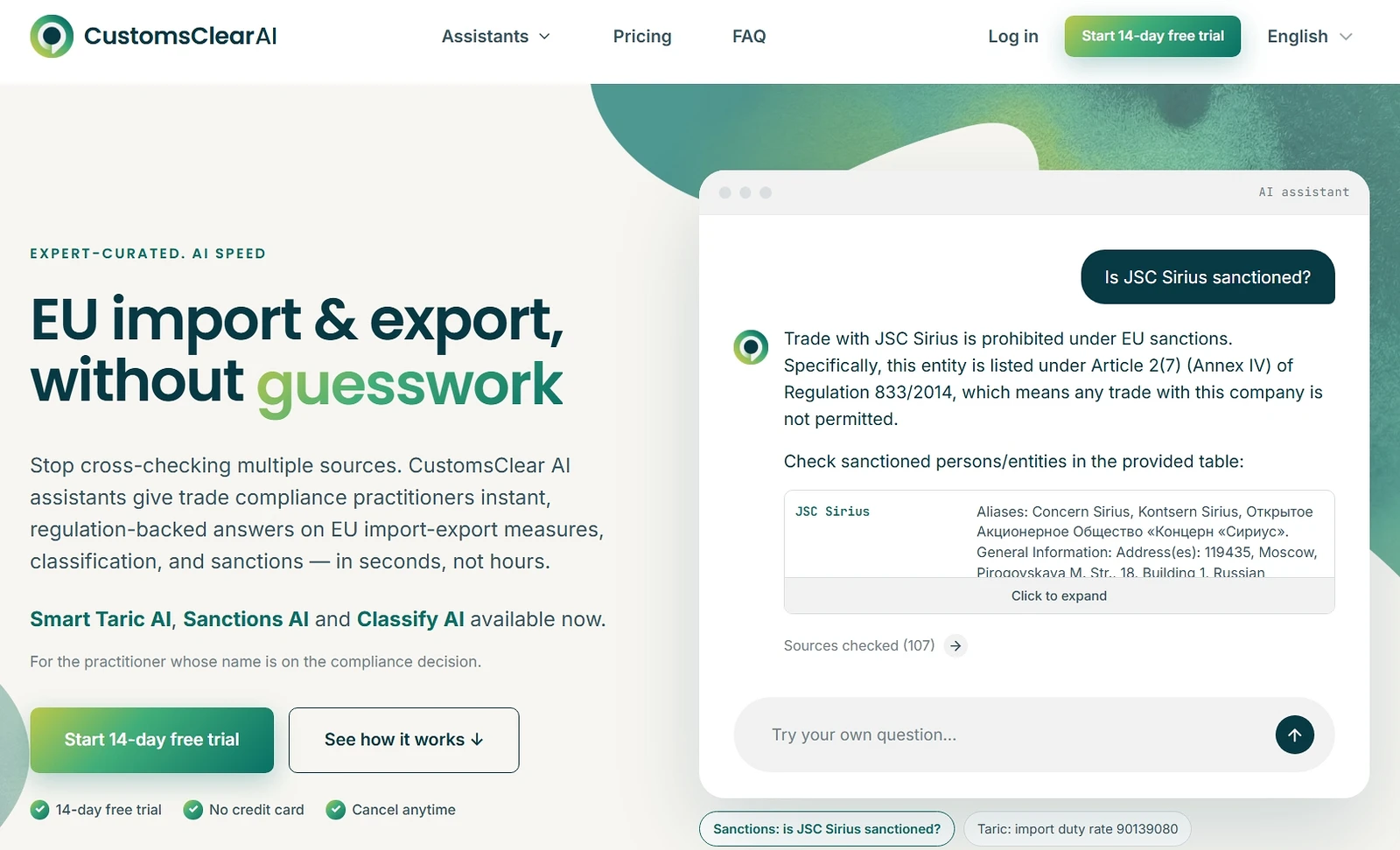
CustomsClear AI assistants are specialised tools for customs and trade compliance professionals who need to research and substantiate decisions before or alongside the customs declaration process. Rather than functioning as declaration-filing software, the platform concentrates on three areas where practitioners regularly have to cross-check multiple legal sources: tariff classification, TARIC measures and sanctions. Its current suite consists of Classify AI, Smart Taric AI and Sanctions AI.
Classify AI supports classification research through three modes and draws on classification regulations, BTI rulings and CJEU judgments. Smart Taric AI interprets EU tariff and non-tariff measures attached to commodity codes, including duties, quotas, certificates and restrictions, with national tax coverage being expanded across the 27 EU member states. Sanctions AI checks counterparties and trade scenarios against sanctions information while also covering EU controls connected with dual-use and military goods. The assistants return answers with references to the underlying legal sources, allowing practitioners to verify the basis of the result rather than relying on an unexplained AI recommendation.
The platform's principal advantage is therefore depth at the decision-support stage of customs compliance. CustomsClear has built its AI tools around an expert-curated knowledge base maintained by practising customs professionals, lawyers and former customs officials rather than positioning a general-purpose language model as the source of the legal conclusion. Its limitation is equally important for buyers to understand: CustomsClear AI is not presented as a full customs declaration or customs-management system. Businesses requiring direct declaration submission, comprehensive broker workflows, or extensive ERP-based customs execution would normally need separate operational software alongside it.
CustomsClear AI facts
Founded: 2019, developed by CC Learning, UAB, trading as CustomsClear. CustomsClear is also the company behind the CustomsClear.net professional knowledge platform and Picoco AI infrastructure for regulatory assistants.
Best for: EU importers, customs professionals, brokers and trade-compliance teams that need faster classification research, TARIC analysis and sanctions checks with direct access to supporting legal sources.
Core strengths: AI-assisted tariff classification, EU TARIC research, tariff and non-tariff measure analysis, sanctions screening, historical commodity-code research, BTI and CJEU source research, and regulation-backed responses with source traceability.
Client reviews: They have a 5/5 rating from Google reviews. CustomsClear itself lists organisations including DHL, Schneider Electric, Thermo Fisher Scientific, PwC, FedEx Express and Bosch among companies using or trusting its wider platform.
Professional expertise: The platform's underlying knowledge environment is developed with more than 100 practising customs professionals, lawyers and former customs officials. CustomsClear has also developed customs-focused conversational AI used by Lithuanian Customs, providing additional evidence of its specialisation in regulatory knowledge systems.
Core specialties: EU tariff classification, TARIC measures, customs legal research, sanctions and export-control checks, regulatory source verification, and AI-supported customs decision-making.
Advantages: Strong EU customs specialisation, purpose-built assistants for distinct compliance tasks, answers linked to underlying regulations, expert-curated source material, historical checks in relevant tools, and a relatively focused workflow for practitioners who do not require a large enterprise customs-management system.
Disadvantages: It does not replace customs declaration-filing software and is considerably more EU-focused than global trade-management suites such as Descartes. Businesses seeking end-to-end declaration submission, extensive customs-procedure management, or broad ERP-connected trade execution would require additional software.
3. MIC-CUST – global customs filing and trade compliance management
MIC-CUST is designed for managing customs declarations across numerous jurisdictions from a central platform. Its import and export solutions support automated filing in more than 55 countries, with direct connections to national customs systems and integration with ERP environments.
The wider MIC environment also covers customs tariff and export-control classification, denied-party screening, origin management and trade content for more than 150 countries. Its newer classification tools incorporate AI-assisted recommendations, while MIC-CUST itself remains strongly oriented towards operational customs execution.
MIC-CUST is therefore particularly relevant to multinational businesses seeking to standardise customs processes across countries. Its main limitation is proportional to that ambition: organisations with comparatively simple customs operations or primarily research-driven needs could find the platform broader than necessary.
MIC-CUST facts
Founded: 1988. MIC is headquartered in Austria and reports more than 600 employees and over 1,000 customers.
Best for: Multinational companies with high customs volumes that need centralised import and export filing across multiple jurisdictions.
Core strengths: Import and export declarations, direct customs-authority connectivity, special procedures, tariff classification, export controls, sanctions screening and ERP integration.
Client reviews: MIC has a limited presence on major independent software-review platforms. Its published customer base includes companies such as BMW Group, DHL, Bosch, Volkswagen Group and Zalando. Zalando reports that its MIC implementation reduced export-processing lead times by 75%.
Core specialties: Global customs filing, customs process automation, classification, export controls, special procedures and enterprise trade compliance.
Advantages: Broad international filing coverage, one central technical platform, direct customs-system connectivity and strong support for complex multinational customs operations.
Disadvantages: Its enterprise scope can involve greater implementation complexity than specialist compliance tools, particularly for smaller businesses that do not require extensive filing infrastructure.
4. AEB Customs Management – integrated customs operations and filing
AEB Customs Management is designed for companies that want to manage declaration filing and related customs processes within one connected environment. It supports direct import and export filing in several European markets, alongside broker integration for businesses that continue to outsource part of their customs activity. The platform can also connect with SAP and other ERP systems, making it particularly relevant for organisations handling customs at scale.
AEB extends beyond declaration submission. Its wider customs suite includes product classification, customs warehousing, origin and preference management, and supplier declarations. Product Classification combines global tariff content with AI-supported classification and centrally managed master data, while Origin & Preferences automates origin calculations using operational data such as purchase orders and bills of materials.
Its main advantage is the connection between customs execution and the data supporting it. Businesses can use direct filing in relevant jurisdictions or integrate customs brokers through the same platform. The trade-off is implementation breadth: organisations looking only for lightweight customs research or occasional classification assistance can find the platform more extensive than their requirements.
AEB facts
Founded: 1979 in Germany. AEB has operated in global trade software for more than 40 years and serves over 7,000 customers internationally.
Best for: Mid-sized and larger companies requiring customs declaration filing, broker integration and customs processes connected with ERP systems.
Core strengths: Import and export filing, customs broker integration, product classification, origin management, customs warehousing and SAP/ERP integration.
Client reviews: AEB publishes customer case studies rather than relying heavily on public review platforms. AUTODOC reports a 50% reduction in customs-clearance time, while Atlantic uses AEB Customs Management to process around 45 million parcels annually.
Core specialties: Customs filing, multi-country customs management, tariff classification, preferential origin and broker-connected workflows.
Advantages: Strong customs execution capabilities, direct connections with customs authorities in several European markets, flexible broker integration and extensive ERP connectivity.
Disadvantages: Broader implementation requirements than lightweight compliance tools, while direct-filing availability differs by country and between import and export processes.
5. Customs4trade CAS – automated multi-country customs management
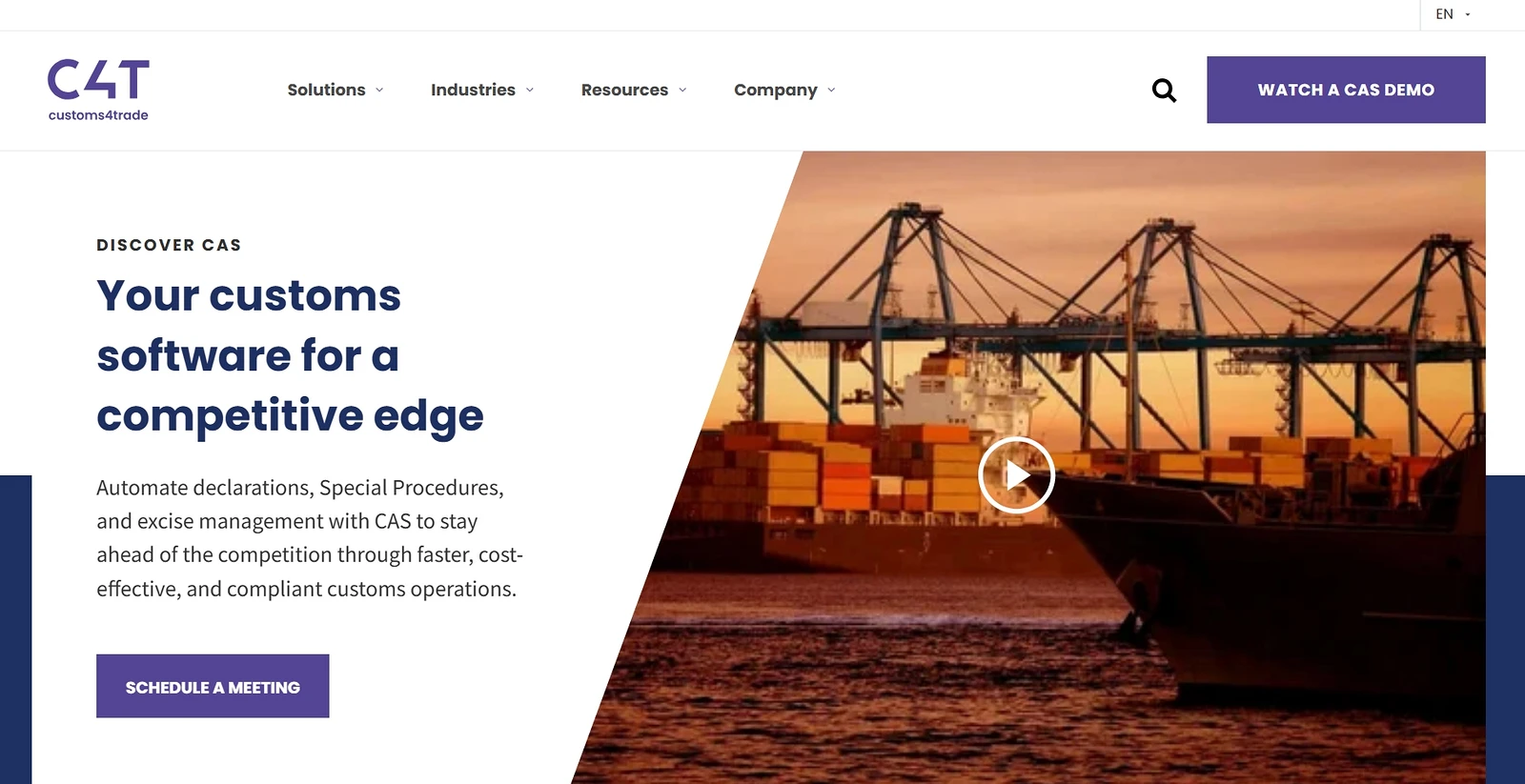
Customs4trade CAS is a cloud-based customs automation platform built around declaration filing, special procedures and excise management. It centralises customs data, declaration statuses and duty costs across countries, with direct connections to customs authorities and continuously updated legal content.
Its declaration module automates import, export and transit submissions and currently provides direct filing connections in Belgium, the Netherlands, the UK, Ireland and France. CAS also includes customs warehousing, inward and outward processing, master-data management, reporting and AI-assisted product classification. Its 'Single Message Double Filing' function can generate export and corresponding import declarations from one data submission.
CAS is strongest where businesses want to bring high-volume customs activity into a centralised system and reduce reliance on manual declaration preparation or brokers. The trade-off is scope: smaller teams primarily seeking regulatory research, sanctions analysis or occasional classification support could find a full customs-automation environment unnecessarily extensive.
Customs4trade CAS facts
Founded: 2004 in Belgium, initially as a customs consultancy before developing its technology platform.
Best for: Importers and exporters handling substantial declaration volumes across several European customs jurisdictions.
Core strengths: Automated customs declarations, special procedures, excise management, AI product classification, master-data management, analytics and ERP/API integration.
Client reviews: CAS has a limited independent review footprint on G2, with one verified review giving the platform 5/5. Customs4trade also publishes customer cases involving companies including Ideal Standard, Agristo, Reynaers and Olenex.
Core specialties: Multi-country declaration automation, customs self-filing, special procedures, excise operations and centralised customs data management.
Advantages: Direct customs-authority connectivity, strong declaration automation, multi-country management, integrated customs procedures and scalable ERP-connected workflows.
Disadvantages: Direct filing does not cover every jurisdiction, while the platform's operational breadth is less suited to teams requiring only focused customs research or compliance decision support.
6. SAP Global Trade Services – enterprise customs and trade compliance
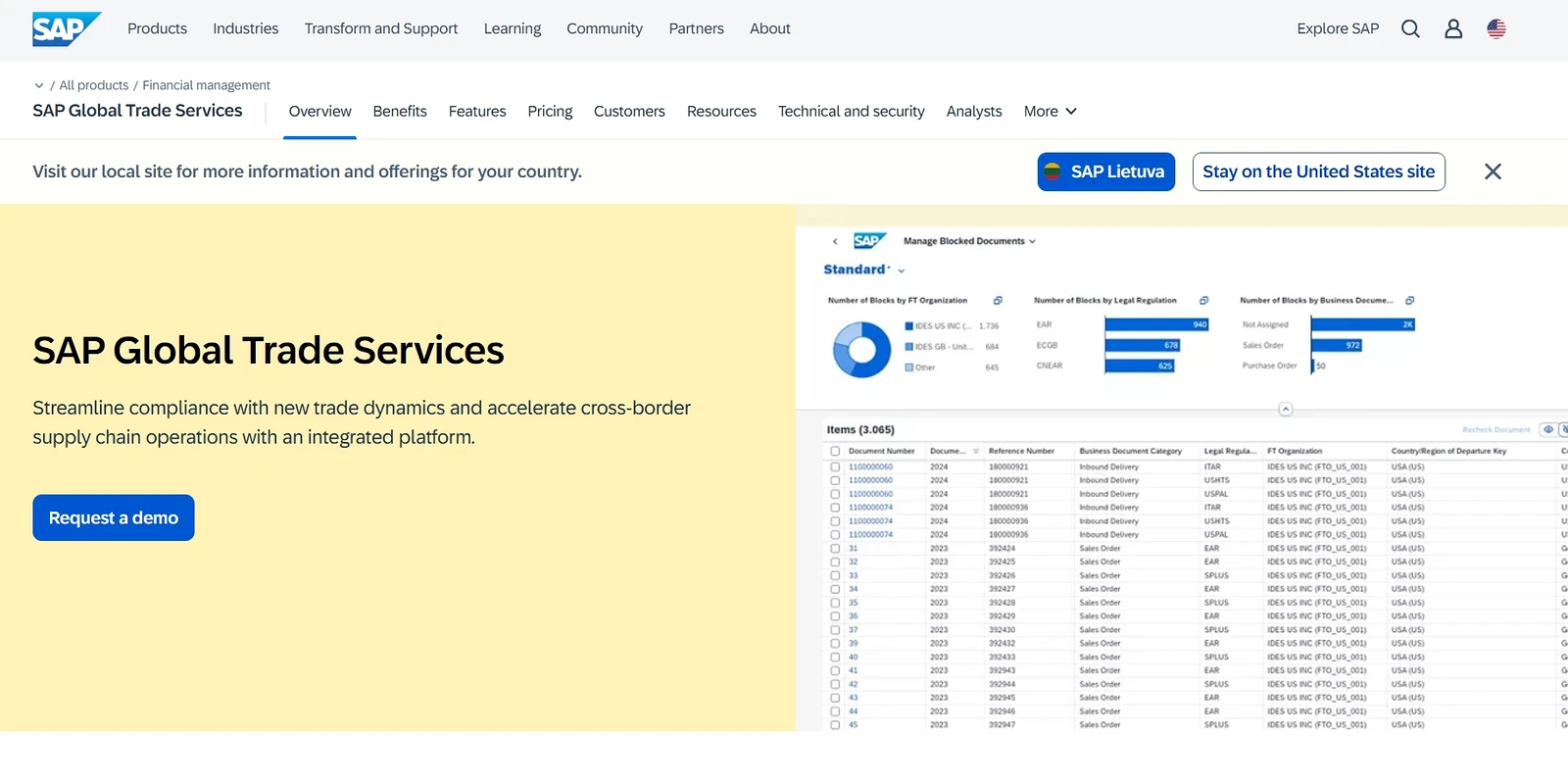
SAP Global Trade Services (SAP GTS) is an enterprise platform for companies that need customs management to operate alongside broader trade-compliance controls. It combines import and export management with tariff classification, sanctioned-party screening, licence controls, preference management and special customs procedures. The system also connects with customs authorities for electronic filing and can draw transaction data from SAP or other feeder systems.
Its strongest use case is a complex organisation already managing substantial trade volumes through ERP-based processes. Customs declarations can be created from purchasing, delivery and other logistics data, while compliance checks can run within the same workflow. SAP GTS also supports procedures including bonded warehousing, inward processing, transit and Intrastat reporting.
The breadth is considerable, although so is the implementation requirement. SAP GTS is consequently better suited to established enterprise trade environments than teams looking for a focused customs research or standalone AI compliance tool.
SAP Global Trade Services facts
Founded: SAP was founded in Germany in 1972. SAP Global Trade Services is part of its wider enterprise software portfolio.
Best for: Large organisations, particularly existing SAP users, requiring customs filing and trade compliance to integrate closely with ERP and supply-chain processes.
Core strengths: Customs declarations, tariff classification, sanctioned-party screening, import and export controls, preference management, special procedures and ERP integration.
Client reviews: SAP GTS holds a 4.3/5 rating from 56 reviews on G2. Reviewers frequently highlight automation, SAP integration and compliance screening, while implementation complexity, configuration requirements and the learning curve appear among recurring criticisms.
Core specialties: Enterprise customs management, electronic customs filing, trade compliance, export controls, preference processing and transactional compliance automation.
Advantages: Extensive customs and compliance functionality, strong ERP integration, automated transaction-level controls and support for complex international trade operations.
Disadvantages: Implementation and configuration can require substantial expertise and resources, while smaller customs teams can find the platform disproportionately complex for narrower compliance requirements.
Visit SAP Global Trade Services
7. Thomson Reuters ONESOURCE Global Trade – global regulatory and customs compliance
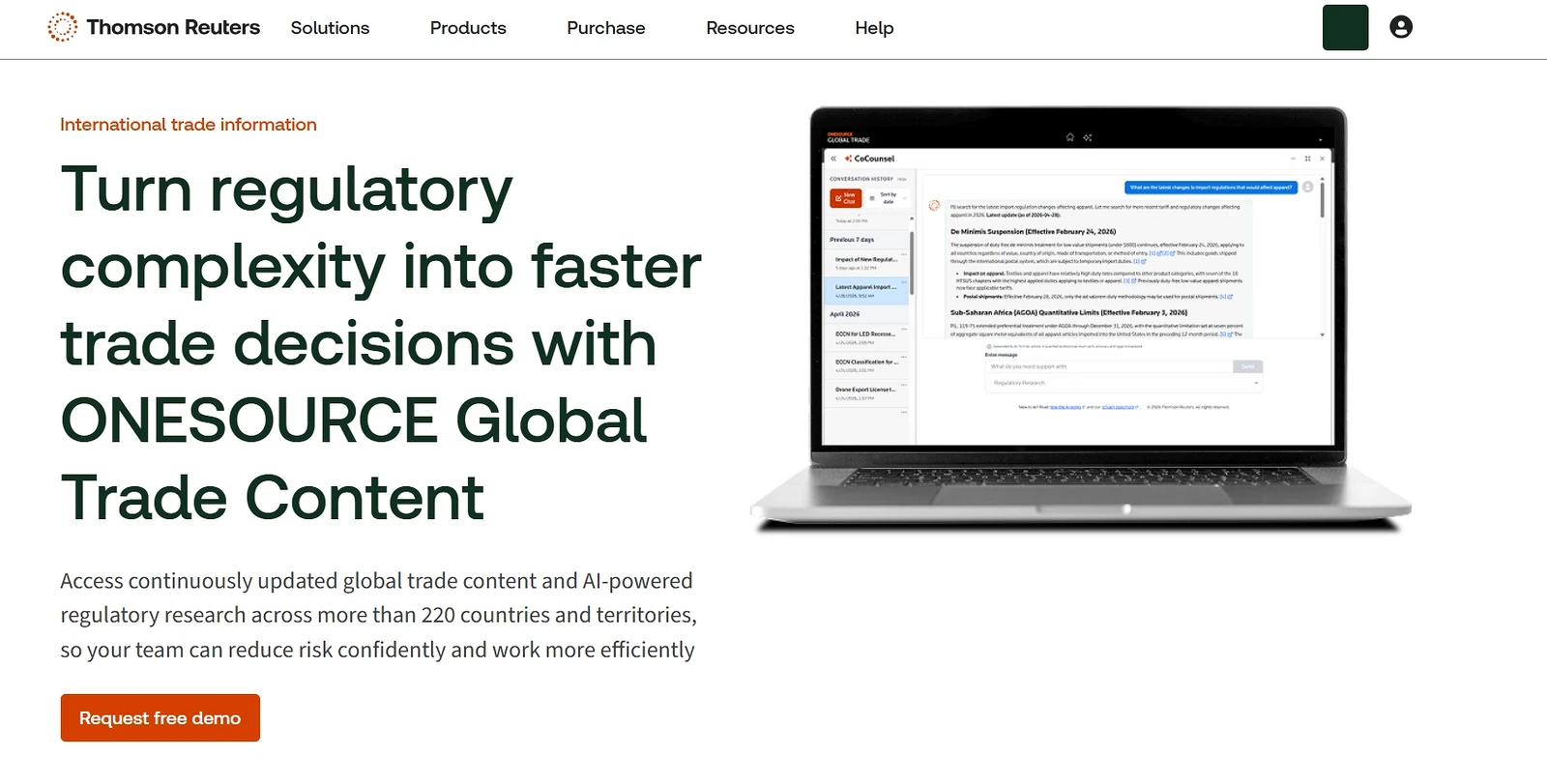
Thomson Reuters ONESOURCE Global Trade combines customs management with regulatory content, classification, screening and import/export controls. It is designed primarily for multinational organisations that need one environment for operational trade processes and compliance information across numerous jurisdictions. Its regulatory content currently extends across more than 220 countries and territories.
For customs operations, ONESOURCE supports import and export management, document control and direct filing with customs authorities in selected countries, including Germany, France, the Netherlands, the UK, the US and China. Its wider suite adds denied-party screening, HS and ECCN classification, duty optimisation and AI-supported regulatory research through CoCounsel.
The platform's advantage is the combination of global regulatory intelligence and enterprise trade management. Its limitation is scale: businesses requiring only EU customs research, occasional classification or a focused compliance assistant could find the broader ONESOURCE environment more extensive than necessary.
Founded: ONESOURCE Global Trade is developed by Thomson Reuters, the global information and technology company formed under the Thomson Reuters name in 2008.
Best for: Multinational companies requiring global regulatory content, customs management, screening and trade-compliance processes within an enterprise platform.
Core strengths: Import and export management, direct customs filing, HS and ECCN classification, denied-party screening, regulatory content, duty optimisation and AI-supported trade research.
Client reviews: ONESOURCE Global Trade currently has no published product reviews on G2, so there is insufficient independent review data for a meaningful user-rating comparison.
Core specialties: Global trade compliance, customs management, regulatory intelligence, product classification, sanctions screening and import/export controls.
Advantages: Extensive international regulatory coverage, broad compliance functionality, direct filing in selected jurisdictions and strong support for complex multinational trade operations.
Disadvantages: Enterprise breadth can increase implementation requirements, and direct customs connectivity is limited to selected jurisdictions rather than the platform's full regulatory coverage.
Customs compliance software 2026 compared
The seven platforms overlap, but they have been built around very different customs problems. Some are primarily execution systems for declarations and customs procedures; others concentrate on regulatory intelligence, classification or wider enterprise trade controls. CustomsClear AI stands out where the priority is the quality and traceability of the compliance decision itself, particularly for EU classification, TARIC measures and sanctions research.
| Software | Strongest area | Best for | Main limitation |
| Descartes | Filing + global trade content | Larger international trade teams | Broad, modular environment |
| CustomsClear AI | EU classification, TARIC and sanctions |
Customs professionals needing source-backed AI decision support |
No direct declaration filing |
| MIC-CUST |
Multi-country customs filing |
Large multinational businesses | Enterprise complexity |
| Customs4trade CAS | Declaration automation | High-volume European customs operations | Primarily execution-focused |
| AEB | Customs filing + ERP workflows | European importers and exporters | Heavier implementation |
| SAP GTS | ERP-integrated customs compliance | Large SAP environments | Significant configuration |
| ONESOURCE Global Trade | Global regulatory intelligence | Multinational compliance teams | Broad enterprise scope |
The distinction is particularly important for teams already using brokers or declaration software. Replacing the filing system will not necessarily improve classification, TARIC interpretation or sanctions research. In that situation, CustomsClear AI can operate as the specialist compliance layer alongside the existing customs workflow, while platforms such as AEB, CAS, MIC-CUST and SAP GTS become more relevant when the priority is executing and automating declarations themselves.
Choosing the right customs compliance software
For many customs teams, the most relevant starting points will be CustomsClear AI and Descartes, although they solve different parts of the problem. CustomsClear AI is stronger for source-backed classification, TARIC interpretation and sanctions research, while Descartes offers a broader environment combining customs filing, trade content and regulatory compliance.
Beyond these two, AEB, Customs4trade CAS, MIC-CUST and SAP GTS become more relevant where declaration execution, ERP integration and multi-country customs operations dominate the requirement. ONESOURCE Global Trade is particularly suitable for multinational teams needing extensive regulatory intelligence. The final choice should therefore follow the customs process that requires the greatest improvement.
Frequently asked questions about customs compliance software
These questions address the practical differences between customs compliance platforms and the capabilities businesses should examine before selecting one.
What is customs compliance software?
Customs compliance software helps businesses manage tasks such as tariff classification, customs declarations, regulatory research, sanctions screening, customs procedures and trade data. The exact scope differs considerably between platforms.
What is the difference between customs compliance software and customs declaration software?
Customs declaration software focuses primarily on preparing, validating and transmitting customs entries. Customs compliance software can extend further into classification, sanctions, regulatory controls, origin, tariff measures and compliance research.
Does customs compliance software submit customs declarations?
Some platforms do, including Descartes, AEB, Customs4trade CAS, MIC-CUST and SAP GTS. Others, including CustomsClear AI, support the compliance decisions behind declarations rather than submitting them directly.
What should businesses look for in customs compliance software?
The most important factors include filing capability, tariff classification, sanctions controls, regulatory source traceability, jurisdictional coverage, integration options and fit with the organisation's existing customs workflow.
Which customs compliance software is best for EU customs research?
CustomsClear AI is particularly suited to EU-focused classification, TARIC and sanctions research, especially where practitioners need AI-assisted answers linked to underlying regulatory and legal sources.